fbpx

2m2x series – Punching Above Your Weight with AI

Full recording of 2m2x Ep. 148, How AI Helps Underdogs Win


Think AI is only for companies with massive budgets and large engineering teams? Think again. For small and mid-sized businesses, AI isn’t just a productivity tool—it’s a leveling mechanism. And the organizations that understand this first are the ones that will leap ahead.

The SMB Reality—and Why It’s Changing

If you’re leading a small or mid-size business today, you know the constraints. Limited budgets, smaller talent pools, and fewer resources than your enterprise competitors. Traditionally, that gap was nearly impossible to close. But AI is fundamentally rewriting that equation.
For the first time, SMBs can operate with capabilities that look a lot closer to enterprise scale—without enterprise-level spend. Here’s how.

1. Overcoming Budget Constraints
You don’t have millions to spend on large teams or complex systems. But AI automates the repetitive work that used to require headcount: customer support, content generation, data analysis, and more.
The result? A smaller team produces significantly more output. You’re not just cutting costs—you’re multiplying what your existing team can do.

2. Amplifying Talent
You may not have deep specialists across every function. But AI can take the knowledge of your best people and scale it—providing approaches, insights, and guardrails, and proactively escalating problems. It’s like quadrupling your senior leadership without adding a single hire.

“AI can take the knowledge of your experts and scale it—as if you just quadrupled your senior leadership.”

3. Scaling Without Proportional Headcount
Large companies win through scale: more outreach, more operations, more execution. AI lets you compete on that dimension without the associated hiring. Whether it’s handling thousands of customer interactions simultaneously or delivering hyperpersonalized experiences at volume, AI makes scale accessible.

The Leapfrog Opportunity

When you combine lower cost, augmented talent, and scalable output, something interesting happens: you don’t just keep up—you start to leapfrog.

Here’s how to get started:

  1. Identify where AI can multiply your existing strengths.
  2. Focus on high-impact use cases where the biggest gains exist.
  3. Build internal capability, but also test and ensure quality.
  4. Move fast. The advantage doesn’t go to the biggest—it goes to the fastest adopters who execute well.

You may be the underdog today. But with AI, you don’t have to stay there.

Ready to Punch Above Your Weight?

Informulate helps small and mid-sized businesses design and deploy AI strategies that deliver real results. Reach out at [email protected] to start the conversation.

2m2x series – How to Spot a Fake AI Expert

Full recording of 2m2x Ep. 147, How to Spot a Fake AI Expert


Is your AI partner solving real problems—or just selling polished demos? In this episode, we break down how to separate true AI professionals from surface-level hype. From demanding measurable outcomes to evaluating long-term strategic thinking, choosing the right partner may be the difference between real transformation and expensive disappointment.

If you are evaluating AI partners right now, you are facing a real problem. Suddenly, everyone is an AI expert. Agencies, freelancers, solopreneurs — they all claim deep AI capability. And to be fair, it is not entirely their fault. AI demos are incredibly compelling. A polished prototype can be built in minutes or hours and it can look like a finished product.

But here is the issue: demos are easy. Delivering real business outcomes is not.

So how do you separate the pretenders from the professionals?

  1. Real Expertise Shows Up in Track Records

Genuine AI capability shows up in solving business problems reliably, securely, and over the long term. You need to see the track record. If the conversation does not start with ensuring quality or the specifics of the use case, you are already off track.

  1. Demand Outcomes, Not Promises

Ask for specifics. Where has this worked before? What metrics were moved? What failed, and what did you learn from it? If a prospective partner cannot point to deep experience, you are looking at surface-level capability.

  1. AI Requires Systems Thinking

AI is a technology — and like all technology, it needs systems thinking. Real implementations require:

  • Data readiness
  • Workflow integrations
  • Change management
  • Security planning
  • Ongoing evaluation

Anyone who skips over the complexity of certain implementations is either inexperienced or selling you something incomplete.

  1. Look for Partners Who Educate, Not Just Sell

A credible AI partner will slow you down when needed, challenge your assumptions, and help you understand trade-offs. If everything sounds easy, fast, and guaranteed — you are being sold to, not advised.

What Long-Term Partnership Actually Looks Like

At Informulate, we have had 10-plus year relationships with multiple clients. We know that for long-term trust to be built, a partner must bring three things together: strategic experience, state-of-the-art technical skills, and deep customer focus. When those three are present, you get AI solutions that actually deliver — not just in the demo, but in the real world, every day.

2m2x series – The Next Evolution of AI Development

Full recording of 2m2x Ep. 146, The Next Evolution of AI Development

Still using AI just to write code? That’s only the beginning. In this episode, we break down the four phases of AI-enabled software development—from coding and testing to workflow orchestration and product intelligence. The real competitive advantage comes when AI shapes the entire development lifecycle, not just the codebase.

Still Using AI Just to Write Code? That’s Only the Beginning.

Most software teams have adopted AI. Almost none of them have moved past the first phase.

There is a common and costly pattern: a team adopts an AI coding assistant, sees some productivity gains, and concludes they have an AI strategy. What they have actually done is optimize one narrow slice of a much larger system — and left the majority of the value untouched.

Real AI-enabled software development follows four phases. Most teams are stuck in Phase 1. Here is what it looks like when you move through all four.


Phase 1: Coding — The Entry Point, Not the Destination

AI-assisted coding is where almost every team begins. It is visible, measurable, and easy to justify. Developers move faster, boilerplate shrinks, and context switching improves.

But the ceiling here is easy to miss. Getting consistent quality requires well-architected context engineering and opinionated frameworks. Even when done well, you are still performing local optimization — improving one piece of the system while everything around it stays the same.

“If you are only using AI for coding, you are optimizing the smallest part of the system.”


Phase 2: Testing — AI Starts to Validate

In Phase 2, AI shifts from builder to validator. Unit test generation, test case expansion, functional test simulation. AI is no longer just writing code — it is checking it.

This reduces defects and tightens feedback loops. But testing still operates within a silo. The broader flow of how software gets planned and shipped has not changed yet.


Phase 3: Workflow Orchestration — The Stage Most Teams Never Reach

Phase 3 is where AI begins connecting the system rather than operating in isolated parts of it. In practice this looks like:

•       Meeting transcripts automatically generating user stories

•       Tickets written and linked without manual handoffs

•       Code changes connected to test coverage

•       Gaps in user journeys flagged before they become production issues

This is the shift from AI as a collection of tools to AI-enabled workflows. The connective tissue between planning, development, and testing starts to form.


Phase 4: Product Intelligence — AI Shapes What Gets Built

Phase 4 is where AI moves into product thinking itself, not just execution. At this stage AI can:

•       Review usage reports and vision documents together, surfacing patterns humans miss

•       Prioritize features based on data rather than gut feel

•       Simulate outcomes before committing to build them

•       Design validation experiments to test assumptions early

This is a qualitative shift. AI is no longer accelerating how work gets done — it is influencing what work gets done in the first place.


Competitive Advantage Is in the Span

The compounding value of AI in software development does not come from any single phase. It comes from AI spanning code quality, workflows, and product decisions — operating across the full system. Each phase builds on the last, and the organizations that move through all four will carry a structural advantage over those that do not.

Most teams are sitting on Phases 2, 3, and 4 without realizing it. The path forward is clearer than it looks. If you need help getting there, reach out to Informulate.

2m2x series – AI and the Death of Nuance

Full recording of 2m2x Ep. 145, AI and the Death of Nuance

Is the AI debate becoming dangerously polarized? As extreme voices dominate the conversation, nuance is getting lost—and that’s a problem. In this episode, we explore why AI isn’t a simple yes-or-no decision, and why the future depends on balancing innovation with thoughtful regulation

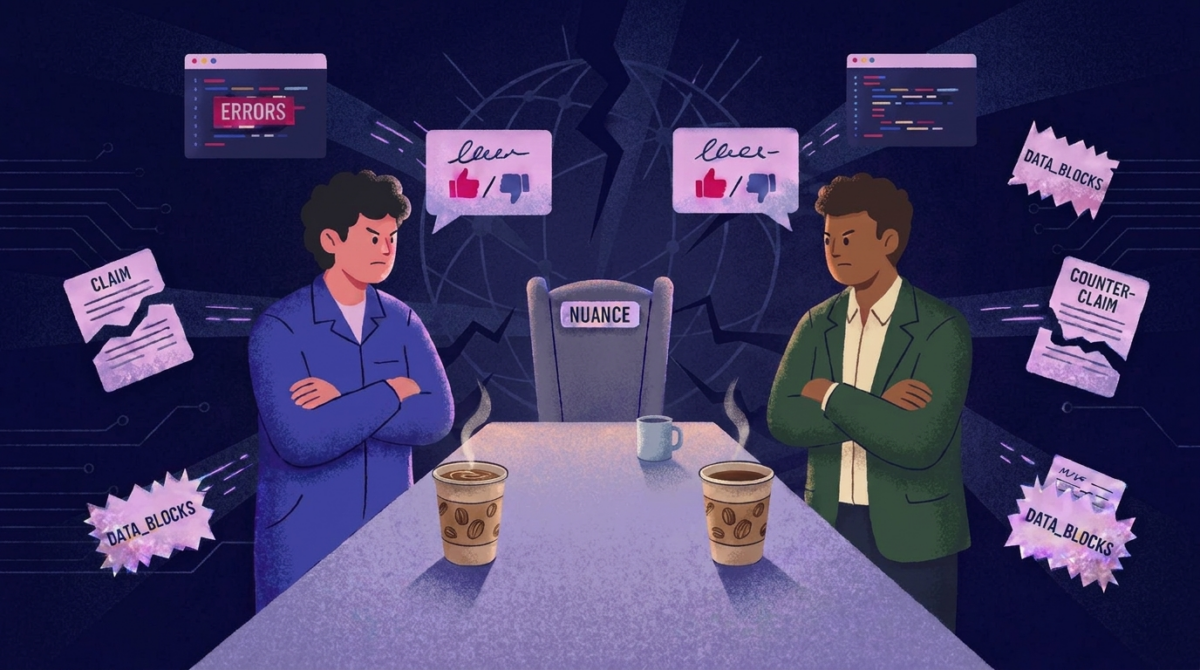
The AI Debate Has a Nuance Problem.

We have a polarization problem. And it is making every other challenge we face harder to solve.

Political discourse, cultural debates, technology conversations — the pattern is the same everywhere. We have stopped debating ideas. The goal now is to destroy the opponent. And the incentive structure rewards extremity: if you are not extreme, you are simply
ignored. 
Gen AI has been fully absorbed into this dynamic. And that is a problem — because the decisions we make about AI over the next several years will matter enormously, and bad framing produces bad decisions.


Two Camps, Both Partially Right

On one side are the utopians. They believe AI is an unambiguous force for good and that any attempt at governance
is a threat to be neutralized. A recent petition circulating in tech circles made this explicit: don’t let governance interfere with AI development. 
On the other are the doomsayers. They are rallying to shut down new AI data centers and pause development entirely, driven by genuine concern about where unchecked AI leads. Here is the honest assessment of both positions: they each contain valid points, and they are both dangerously incomplete.


What the Concerns About AI Get Right

The risks associated with AI are real and deserve to be taken seriously, not dismissed as fear-mongering.

  • AI will cause job displacement. This is already happening and will accelerate.
  • At scale, AI infrastructure increases energy consumption significantly.
  • Self-training AI systems those that can modify their own behavior — carry serious implications for human oversight and control.


These are not hypothetical concerns. They are the predictable consequences of deploying a powerful technology without adequate frameworks for managing its effects.


What the Case for AI Gets Right

The argument for continuing AI development is equally grounded in reality.

  • AI is accelerating medical research in ways that will save lives.
  • AI can help model, predicts and mitigate the effects of climate change.
  • AI-enabled productivity and innovation are becoming competitive necessities, not optional upgrades.


Unilateral restraint does not pause AI development globally. It simply shifts where the decisions get made
and who makes them. Stepping back is not a neutral choice.


The False Binary and the Path Forward

The framing of yes-to-AI versus no-to-AI is a false choice. It reduces a genuinely complex set of tradeoffs to a bumper sticker, and it pushes thoughtful people out of a conversation that needs them.


There are many options on how to proceed. What the moment requires is not louder voices from either extreme. It
requires clearer thinking from people willing to engage with both sides of the tradeoff honestly.


That means three things:

  • Thoughtful adoption —deploying AI where it demonstrably creates value, with clear eyes about where it creates risk
  • Measured regulation — governance frameworks that protect people without freezing the development of genuinely beneficial technology.
  • Clear-eyed realism — honest engagement with both the promise and the peril, without retreating into either cam
 “The future shouldn’t be shaped by those who shout louder. It should be shaped by those who understand the tradeoffs better.”


Getting AI right is not a political act. It is a leadership act. Organizations that bring genuine rigor to these tradeoffs — rather than defaulting to the nearest tribe — will make better decisions, build better products, and earn more trust from the people they serve.


If you are working through how to approach AI adoption and governance in your organization, reach out to Informulate.

2m2x series – Why Most AI Agents Will Fail

Full recording of 2m2x Ep. 144, Why Most AI Agents Will Fail

Everyone is building AI agents, but most won’t make it to production. From security risks to lack of oversight, the failure patterns are already emerging. In this episode, we break down five essential best practices, from guardrails to observability, that separate scalable, high-quality agents from costly mistakes. 

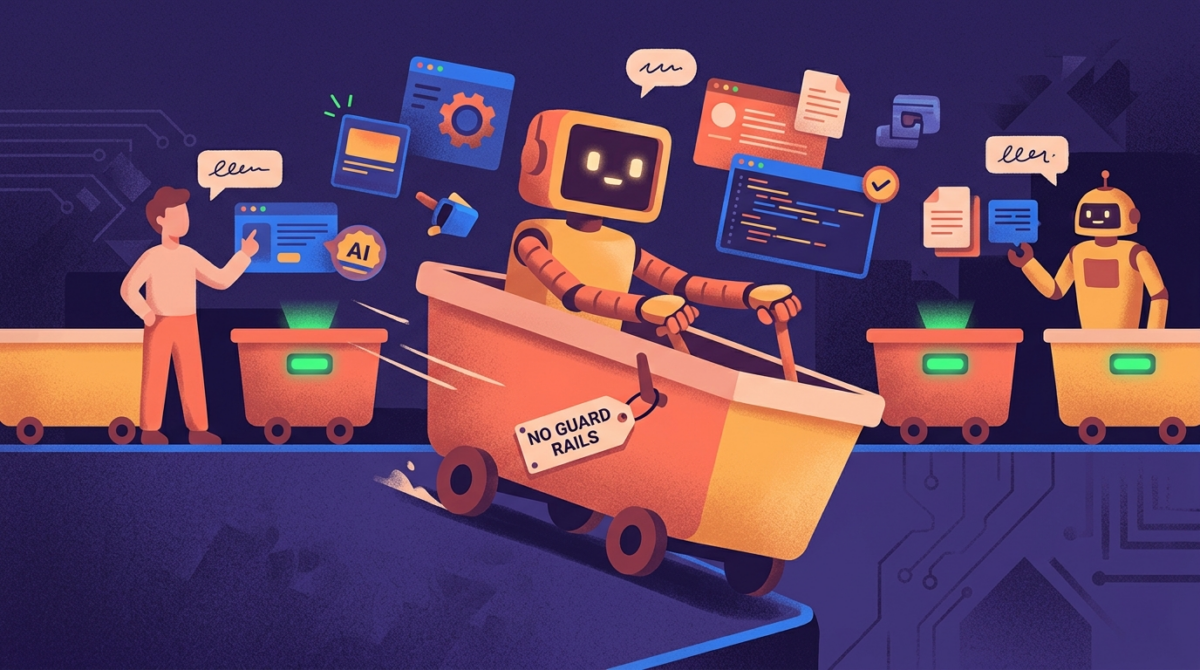
The rush to deploy AI agents is accelerating faster than the discipline to deploy them responsibly. Organizations across every sector are standing up autonomous systems, agents that browse, decide, call APIs, and act — with the same trial-and-error energy that characterized early mobile app development. The difference is the stakes. A poorly built mobile app gets one-star reviews. A poorly built AI agent leaks sensitive data, acts on hallucinated inputs, or executes decisions that cannot be undone.

Gartner projects that over 40% of agentic AI projects will be scrapped by 2027. That number is not a forecast of technological failure — it is a forecast of organizational failure. The agents that survive will not necessarily be the most capable. They will be the most carefully governed.


The Asymmetry That Changes Everything

The foundational difference between a conversational AI and an agentic AI is consequential action. A chatbot that produces a wrong answer stops there. An agent that receives wrong input keeps moving, calling tools, writing records, sending messages, escalating workflows. The error compounds with every step.

This asymmetry means that the failure modes of agentic AI are categorically different from those of simpler AI systems. OWASP’s GenAI Top 10 for 2025 catalogs exactly where agents break: prompt injection, tool misuse, memory leakage. These are not theoretical vulnerabilities. They are patterns already observed in production deployments, and any team building agents without awareness of them is accepting risk they have not quantified.

“The agents that survive won’t be the most capable. They’ll be the most carefully governed.”


Trust Is Earned Incrementally, Not Assumed

The most effective agentic deployments start narrow. A single workflow. A constrained decision space. A clear definition of what the agent is authorized to do and what requires escalation. Snowflake’s approach to agent adoption articulates the principle clearly: expanding capabilities after trust is established is far easier than recovering adoption after a public failure.

Starting narrow is not a limitation, it is a strategic choice. It creates the evidence base needed to justify expansion. It surfaces edge cases in a controlled environment. And it builds the organizational confidence required for agents to take on more consequential work over time.


Observability and Versioning Are Not Optional

Two practices separate mature agentic programs from fragile ones: observability and versioning. Observability means having a complete audit trail of every decision an agent made, every API it called, and every action it took. Without it, debugging is guesswork and regulatory compliance is impossible. McKinsey’s research found that only 17% of enterprises have a formal governance structure around AI, a gap that represents both enormous risk and competitive opportunity for those who close it first.

Versioning applies not just to code but to the full stack of agent behavior: prompts, tools, and evaluation datasets. Production releases should be gated behind evaluation thresholds. Without this discipline, regressions are invisible until they cause incidents, and rollbacks become reconstructions rather than reversions.


The Human Checkpoint

No discussion of agentic AI governance is complete without addressing the question of autonomy limits. The drive to remove humans from workflows is understandable, it is, in many cases, the entire point. But unchecked autonomy on high-stakes decisions is not a feature; it is a liability.

Any agent operating in sensitive domains, finance, HR, legal, healthcare, customer data, requires defined human checkpoints. Not because AI judgment is inherently untrustworthy, but because accountability requires a human in the chain. Non-auditable agents that take consequential actions without any human review should not exist in production systems. The goal is not to slow down automation; it is to make it defensible.


Organizations that apply these principles, narrow scope, mandatory guard rails, full observability, rigorous versioning, and human oversight on high-stakes decisions, are the ones that will be expanding their agentic programs in 2027 while others are explaining why theirs were scrapped.

Informulate helps organizations build AI agents that are production-ready and governance-complete. Reach out to start the conversation.

2m2x series – The End of Coding as We Know It

Full recording of 2m2x Ep. 143, Why Most AI Agents Will Fail

Is traditional software engineering already obsolete? With AI now writing, testing, and deploying code, the role of the engineer is rapidly shifting. In this episode, we break down the rise of agentic engineering, where developers move from coding to orchestrating outcomes, and what this means for teams, skills, and the future of building software.

Traditional software engineering is being fundamentally disrupted by AI. That gap is not a technology problem. It is an organizational and architectural problem, and it is one that separates the enterprises building durable competitive advantages from those chasing capabilities they do not yet know how to use.

The organizations getting this right are not necessarily the ones with the most advanced AI. They are the ones with the clearest thinking about what AI changes, what it does not, and what it takes to move from experimentation to production.

Code generation is now mainstream

AI writes, tests, and deploys The implications run deeper than they first appear. Most organizations recognize the surface-level change but underestimate the second and third-order effects on team structure, decision-making authority, and the systems that support both.

The developer role is shifting from coder to outcome orchestrator

The developer role is shifting from coder to outcome orchestrator This is where organizations that invested early in the right foundations begin to separate from those that treated the capability as a bolt-on rather than a structural shift.
“Developers are shifting from writing code to orchestrating outcomes, as agentic systems now handle writing, testing, and deploying”

Agentic engineering changes team structures and required skills

Agentic engineering changes team structures and required skills The compounding nature of this shift is what makes the timing consequential. Advantages established now become harder to close, not easier. Organizations that act on the architecture before the window narrows will have optionality that late movers will not.

Organizations that adapt fastest will gain a structural advantage

Organizations that adapt fastest will gain a structural advantage The organizations building this discipline now are not just solving today’s problems. They are establishing the governance and engineering foundations that will determine what they can build next.

2m2x series – AI Is Starting to Run the Show

Full recording of 2m2x Ep. 142, AI Is Starting to Run the Show

Think AI is still just a chatbot answering questions? Think again. A new wave of tools is pushing AI beyond simple responses into action, integrating systems, coordinating workflows, and even anticipating needs before you ask. In this episode, we explore the shift from AI assistants to proactive, agentic systems that could redefine how work gets done.

AI is moving beyond simple question-and-answer interactions into proactive, agentic systems that integrate workflows, coordinate across systems, and anticipate needs. That gap is not a technology problem. It is an organizational and architectural problem — and it is one that separates the enterprises building durable competitive advantages from those chasing capabilities they do not yet know how to use.
The organizations getting this right are not necessarily the ones with the most advanced AI. They are the ones with the clearest thinking about what AI changes, what it does not, and what it takes to move from experimentation to production.

AI is moving from reactive assistant to proactive operator

AI is moving from reactive assistant to proactive operator The implications run deeper than they first appear. Most organizations recognize the surface-level change but underestimate the second and third-order effects on team structure, decision-making authority, and the systems that support both.

Agentic systems integrate across tools, teams, and workflows

Agentic systems integrate across tools, teams, and workflows This is where organizations that invested early in the right foundations begin to separate from those that treated the capability as a bolt-on rather than a structural shift.

“This shift from AI assistant to AI operator is redefining how work gets done across the enterprise”

The shift requires new mental models for how work gets delegated

The shift requires new mental models for how work gets delegated The compounding nature of this shift is what makes the timing consequential. Advantages established now become harder to close, not easier. Organizations that act on the architecture before the window narrows will have optionality that late movers will not.

Early movers are gaining compounding advantages

Early movers are gaining compounding advantages The organizations building this discipline now are not just solving today’s problems. They are establishing the governance and engineering foundations that will determine what they can build next.


Informulate helps organizations move beyond AI experimentation into production-ready systems built for scale, governance, and real-world complexity. Reach out to start the conversation.


2m2x series – Single-Player vs. Multi-Player AI

Full recording of 2m2x Ep. 149, Single-Player vs. Multi-Player AI

Most enterprises have adopted AI in some form. Microsoft Copilot, Gemini, customer service chatbots—the list goes on. But there’s a critical distinction that separates the companies winning with AI from those simply keeping up: the difference between single-player AI and multi-player AI.

What Is Single-Player AI?

Single-player AI is exactly what it sounds like: one user talking to one AI tool, one task at a time. It’s the default mode for most enterprises today—productivity gains for the individual, isolated within a silo.

To be clear, single-player AI isn’t bad. It helps employees work faster. But it comes with hard limits:

  • Productivity gains are uneven—some employees use AI well, others don’t.
  • Work lives in silos, so coordination between teams stays manual.
  • AI only sees one task at a time, so it can’t compound value across the organization.


The Shift to Multi-Player AI

The companies that are going to win the next phase of AI aren’t asking “Which is the best AI tool for my employees?” They’re asking a fundamentally different question: How do we build unique competitive advantages using agentic workflows that tie together entire business processes?
That’s multi-player AI. It means shared context—AI that can talk to other systems, other workflows, and other people. Not just assisting one person at a time, but orchestrating work across the enterprise.

“Not just assisting one person, but orchestrating work across the entire enterprise.”


What Multiplayer AI Looks Like in Practice

Think about what happens when AI moves beyond the individual. Instead of ten employees each running the same research query in Copilot, an agentic workflow pulls live data, synthesizes it across departments, and surfaces a recommendation before anyone even asks. Coordination that used to take days happens in minutes—automatically, consistently, and at scale.
This isn’t science fiction. It’s where the leading enterprises are already heading.


The Hard Work Required

Getting from single-player to multi-player AI isn’t a plug-and-play upgrade. It requires:

  1. Rigorous business analysis to map where agentic workflows deliver the most value.
  2. Solution design to architect the connections between systems and teams.
  3. Building custom agents that can operate within your specific context and data.
  4. A phased, multi-year roadmap that keeps the initiative grounded and measurable.

This is the shift—and for the organizations willing to do the hard work, it’s where durable competitive advantage gets built.

Ready to Make the Move?

Informulate helps enterprises design and implement the agentic workflows that move them from single-player to multi-player AI.

Reach out at [email protected] to start the conversation.

2m2x series – AI Is Not Magic: Tools & Architecture Part 2

Full recording of 2m2x Ep. 140, AI Is Not Magic: Tools & Architecture Part 2 

AI’s limits are real—but so are the solutions. In Part 2, we move beyond the hype and into the architecture, tools, and best practices that turn demos into production systems. From RAG and agentic workflows to human-in-the-loop design, this episode breaks down what it actually takes to build AI that works in the real world. 

In the last episode, we talked about the natural limits of AI, why it’s probabilistic, why the demo is never the whole story, and why edge cases are what separate a compelling proof-of-concept from a production-ready solution.

Now let’s talk about the real magic.

There are tools, techniques, and architectural frameworks that can take you well beyond those limits. But before we get into them, there’s something important to address: not all AI practitioners are created equal.

The Snake Oil Problem

Because generative AI is now so accessible, a new wave of providers has emerged claiming AI expertise. The warning signs are consistent: they build production systems in rapid prototyping tools never designed for scale, they dump massive document repositories into a system and expect techniques that work for megabytes to perform the same way at gigabytes, they write basic prompts and expect them to handle complex real-world situations, and they design poor user experiences that place too much cognitive load on the people actually using the product.

When all you have is a hammer, everything looks like a nail. Low-end providers apply the same generic approach to every problem — and the result is applications that demo well and fall apart in production.

Best Practices Are Not Optional

Just as software engineering has foundational principles — object-oriented design, separation of concerns, normalization and denormalization — AI architecture has its own set of best practices. The difference between an exciting demo and a real-world solution is knowing which tools to use, when, and why.

The techniques that matter most right now include:

  • RAG vs. Graph RAG — knowing when standard retrieval-augmented generation is sufficient versus when a graph-based approach is needed for complex, interconnected knowledge
  • MCP (Model Context Protocol) — enabling AI models to interact with external tools and services reliably
  • Private LLMs — deploying models in controlled, secure environments when data sensitivity requires it
  • Human-in-the-loop — designing systems that know when to escalate to a human rather than guessing
  • Agentic architecture — building AI that can reason, plan, and take multi-step actions autonomously
  • Automated evaluation — systematically testing AI outputs so quality doesn’t degrade over time
  • Streaming, voice, and text-to-speech — choosing the right interaction modality for the use case
  • Prompt engineering — crafting inputs that consistently produce reliable, high-quality outputs
  • Supervised vs. unsupervised learning — understanding which training approach fits the problem

Experience Is the Differentiator

Knowing these terms is a starting point. Knowing when and how to apply them, in combination, at scale, for a specific business context, is where genuine expertise lives. Every business case is different. The right architecture for a customer support AI is not the same as the right architecture for a document intelligence system or a real-time operations assistant.

That judgment, built from experience, not just familiarity with the tools, is what separates a production-grade AI solution from an expensive prototype.

This is Part 2 of a two-part series. In Part 1, we covered the natural limits of AI and why understanding them is essential before deploying any solution.

2m2x series – AI Is Not Magic: Understanding the Limits Part 1

Full recording of 2m2x Ep. 139, AI Is Not Magic: Understanding the Limits Part 1
AI is powerful—but it’s not magic. In this episode, we cut through the hype to explore why flashy demos often fail in the real world. From edge cases and probabilistic outputs to the hidden costs of scaling AI beyond prototypes, we unpack the real limitations holding AI back today—and why understanding them is the first step to building solutions that actually work.

Every week, a new AI product launches with promises of total automation, zero human oversight, and industry-changing results. And then, more often than not, the quiet part follows: the demo worked great, but the real world is a different story.

AI is changing the world. That part is true. But it is not magic. And understanding the difference between those two things is the most important thing any business leader can do right now.

The Desert Is Not the Real World

Remember the DARPA self-driving car challenge in the Mojave Desert? That was two decades ago. Multiple teams successfully navigated the course, and the headlines were electric. Yet here we are in 2026, and fully autonomous vehicles still haven’t taken over urban streets.

Why? Because a demo is not a solution.

The desert was flat, controlled, and predictable. Real-world driving is anything but. It is full of edge cases — the unexpected left turn, the child chasing a ball, the faded lane markings in the rain. And that gap between what works in a demo and what works reliably at scale is exactly where AI hype goes to die.

The Probabilistic Problem

Here is the single most important thing to understand about AI: unlike traditional software, AI is probabilistic. It does not follow deterministic rules. It makes predictions. And predictions are never 100% correct.

This is not a flaw waiting to be fixed, it is the fundamental nature of how these systems work. That distinction has enormous practical implications:

  • AI can generate code, but the larger and more complex the task, the higher the risk of errors. Most of the code AI was trained on is publicly available, and much of that code is poorly written. Senior developers are still essential to review, refactor, and ensure scalability and reliability.
  • AI can generate content, but marketing professionals are still needed to review, refine, and approve. Brand voice, strategic nuance, audience understanding, these still require human judgment.
  • AI can parse and retrieve from large knowledge bases, but there are real limits to how accurately it handles massive, complex datasets, especially when context matters deeply.
  • Self-driving cars will eventually cover most edge cases, but it will cost tens of billions of dollars and likely decades of real-world data collection to get there. Companies like Waymo and Tesla are doing exactly that work.
Why the Hype Gets Ahead of Reality

The pattern is predictable: an AI tool performs impressively in controlled conditions, the demo goes viral, and the marketing machine kicks into overdrive. What doesn’t make the press release is the long tail of edge cases, the need for ongoing human oversight, and the significant investment required to make it work reliably in a production environment.

This is not a reason to avoid AI. It is a reason to approach it with clear eyes.

The organizations that will win with AI are not the ones that believe the hype, they are the ones that understand the limits, build thoughtfully around them, and maintain the human expertise needed to fill the gaps AI cannot.

What This Means for Your Business

Before deploying any AI solution, ask three questions:

  • What are the edge cases where this model will fail, and how do we handle them?
  • Where does human oversight remain essential, and who owns that role?
  • Are we building this to handle the real world, or just the demo conditions?

The natural limits of AI are not obstacles, they are design parameters. Understanding them is what separates a successful AI implementation from an expensive lesson.

This is Part 1 of a two-part series. In Part 2, we’ll explore the tools and architecture that help you build AI solutions with these limits in mind.

We love making an impact!

To request a call, fill out the form below and an Informulate team member will reach out to discuss your project needs.

We are ready to help you succeed!

To request a call, fill out the form below and an Informulate team member will reach out to discuss your project needs.

We love building things!

To request a call, fill out the form below and an Informulate team member will reach out to discuss your project needs.

Submit Your Resume

To apply for this position, fill out the form below and attach your resume in PDF format. A member of our HR team will review your submission and reply accordingly.

We love making an impact!

To request a call, fill out the form below and an Informulate team member will reach out to discuss your project needs.

Digital Transformation

To learn more about our Digital Transformation solutions, fill out the form below and an Informulate team member will reach out to discuss your project needs.

We love making an impact!

To request a call, fill out the form below and an Informulate team member will reach out to discuss your project needs.

We love making an impact!

To request a call, fill out the form below and an Informulate team member will reach out to discuss your project needs.

We love making an impact!

To request a call, fill out the form below and an Informulate team member will reach out to discuss your project needs.

AI Consulting

To learn more about our AI Consulting solutions, fill out the form below and an Informulate team member will reach out to discuss your project needs.

Agentic Automation

To learn more about our Agentic Automation solutions, fill out the form below and an Informulate team member will reach out to discuss your project needs.

Business Intelligence

To learn more about our Business Intelligence solutions, fill out the form below and an Informulate team member will reach out to discuss your project needs.

Team Enrichment

To learn more about our Team Enrichment solutions, fill out the form below and an Informulate team member will reach out to discuss your project needs.

Product Development

To learn more about our Product Development solutions, fill out the form below and an Informulate team member will reach out to discuss your project needs.

Digital Transformation

To learn more about our Digital Transformation solutions, fill out the form below and an Informulate team member will reach out to discuss your project needs.

AI Workflow Review

To learn more about our AI workflow Review, fill out the form below and an Informulate team member will reach out to discuss your project needs.

Process Audit

To learn more about our Process Audit, fill out the form below and an Informulate team member will reach out to discuss your project needs.

Code Review

To learn more about our Code Review, fill out the form below and an Informulate team member will reach out to discuss your project needs.