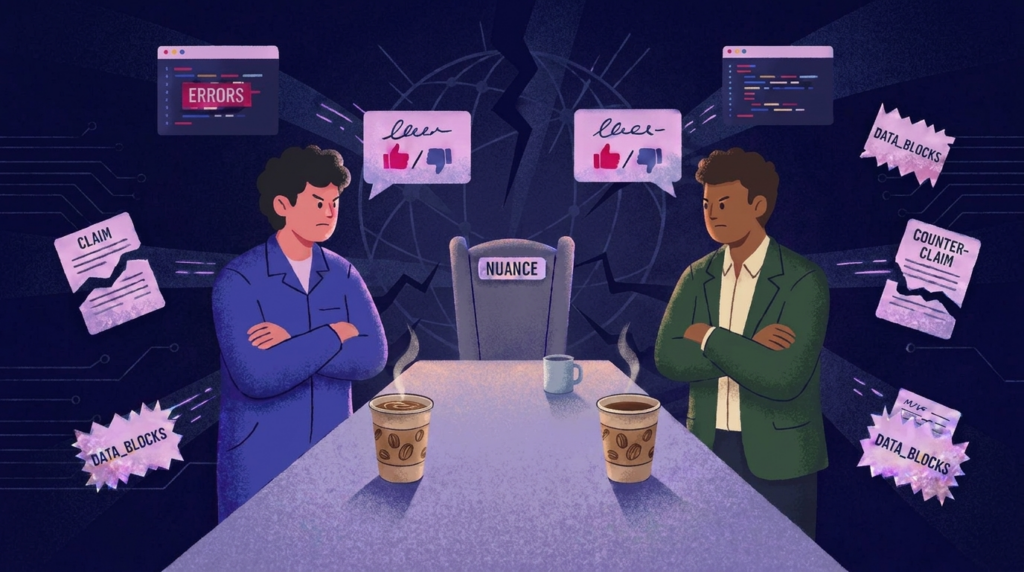
Full recording of 2m2x Ep. 145, AI and the Death of Nuance
Is the AI debate becoming dangerously polarized? As extreme voices dominate the conversation, nuance is getting lost—and that’s a problem. In this episode, we explore why AI isn’t a simple yes-or-no decision, and why the future depends on balancing innovation with thoughtful regulation
The AI Debate Has a Nuance Problem.
We have a polarization problem. And it is making every other challenge we face harder to solve.
Political discourse, cultural debates, technology conversations — the pattern is the same everywhere. We have stopped debating ideas. The goal now is to destroy the opponent. And the incentive structure rewards extremity: if you are not extreme, you are simply
ignored. Gen AI has been fully absorbed into this dynamic. And that is a problem — because the decisions we make about AI over the next several years will matter enormously, and bad framing produces bad decisions.
Two Camps, Both Partially Right
On one side are the utopians. They believe AI is an unambiguous force for good and that any attempt at governance
is a threat to be neutralized. A recent petition circulating in tech circles made this explicit: don’t let governance interfere with AI development. On the other are the doomsayers. They are rallying to shut down new AI data centers and pause development entirely, driven by genuine concern about where unchecked AI leads. Here is the honest assessment of both positions: they each contain valid points, and they are both dangerously incomplete.
What the Concerns About AI Get Right
The risks associated with AI are real and deserve to be taken seriously, not dismissed as fear-mongering.
- AI will cause job displacement. This is already happening and will accelerate.
- At scale, AI infrastructure increases energy consumption significantly.
- Self-training AI systems those that can modify their own behavior — carry serious implications for human oversight and control.
These are not hypothetical concerns. They are the predictable consequences of deploying a powerful technology without adequate frameworks for managing its effects.
What the Case for AI Gets Right
The argument for continuing AI development is equally grounded in reality.
- AI is accelerating medical research in ways that will save lives.
- AI can help model, predicts and mitigate the effects of climate change.
- AI-enabled productivity and innovation are becoming competitive necessities, not optional upgrades.
Unilateral restraint does not pause AI development globally. It simply shifts where the decisions get made
and who makes them. Stepping back is not a neutral choice.
The False Binary and the Path Forward
The framing of yes-to-AI versus no-to-AI is a false choice. It reduces a genuinely complex set of tradeoffs to a bumper sticker, and it pushes thoughtful people out of a conversation that needs them.
There are many options on how to proceed. What the moment requires is not louder voices from either extreme. It
requires clearer thinking from people willing to engage with both sides of the tradeoff honestly.
That means three things:
- Thoughtful adoption —deploying AI where it demonstrably creates value, with clear eyes about where it creates risk
- Measured regulation — governance frameworks that protect people without freezing the development of genuinely beneficial technology.
- Clear-eyed realism — honest engagement with both the promise and the peril, without retreating into either cam
Getting AI right is not a political act. It is a leadership act. Organizations that bring genuine rigor to these tradeoffs — rather than defaulting to the nearest tribe — will make better decisions, build better products, and earn more trust from the people they serve.
If you are working through how to approach AI adoption and governance in your organization, reach out to Informulate.